 iPhone
 Android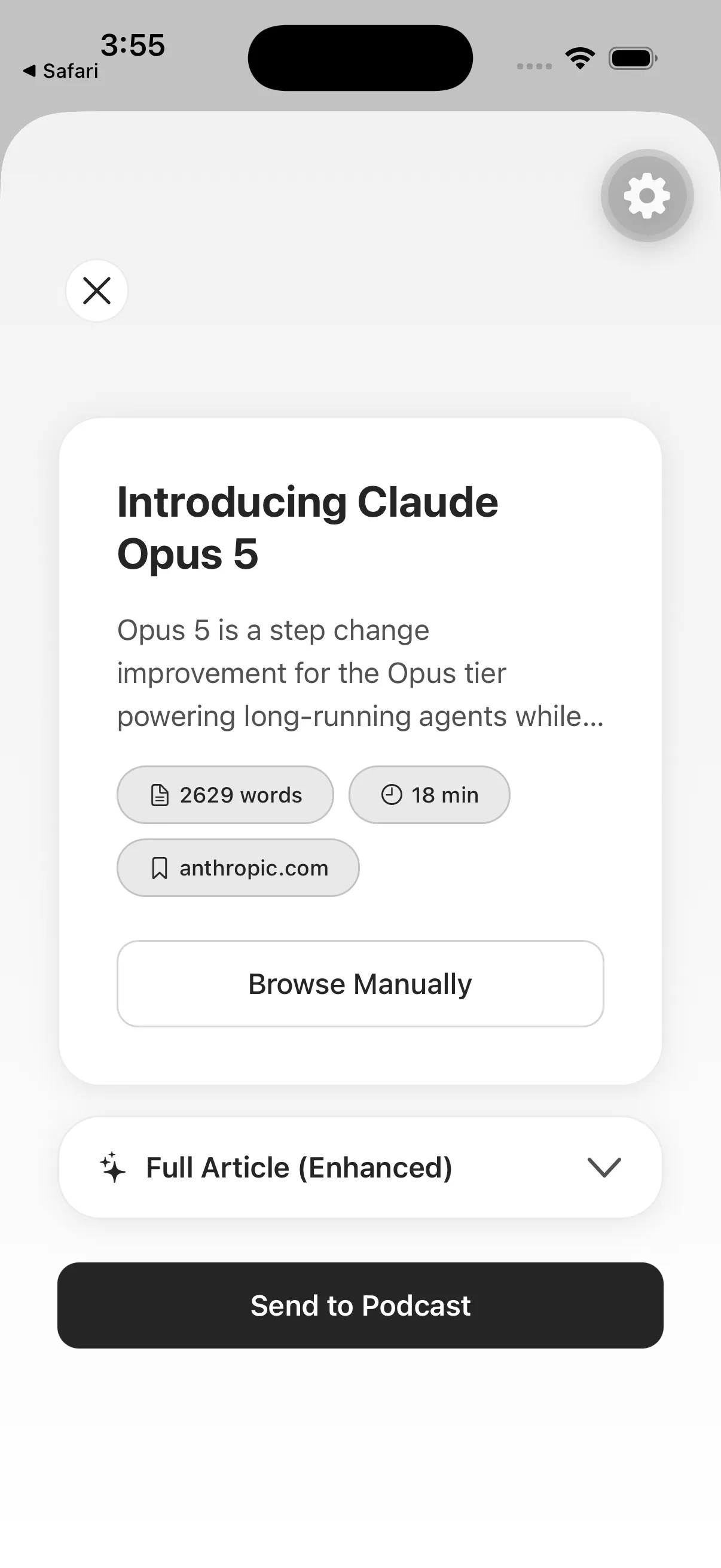
A reading queue that can leave the screen
An article-to-podcast workflow is useful when the article matters but sitting down to read it does not fit the day. Instead of leaving another tab open, save the source when you find it and choose how closely the episode should follow the original.
Spkr keeps each conversion private. The result goes into your personal library rather than being published as a public show. You can listen in Spkr, download an episode for offline playback, or subscribe to your private feed in a supported podcast player.
How to turn an article into a podcast with Spkr
- Save the source. Share the page from iPhone or Android, paste its URL, or capture the current tab with the Chrome extension.
- Choose a listening style. Keep the full article or ask for a shorter, explanatory, question-led, or critical treatment.
- Let Spkr prepare the episode. Spkr extracts the readable source, removes page furniture that does not belong in narration, and creates the requested audio.
- Listen where it fits. Play from the Spkr queue, download the episode, or receive it through your private podcast feed.
The source link remains useful. If a chart, code sample, footnote, or quotation needs visual attention, you can move back to the original article instead of pretending audio replaces every part of reading.
Full article or podcast-style explanation?
Use Full Article when wording and context matter: essays, reporting, interviews, and carefully argued analysis. Use Key Points when you need a fast first pass. Simple Explanation works better for unfamiliar terminology, while Guided Walkthrough turns the source into an active sequence of questions. Devil’s Advocate is designed to test an argument rather than merely repeat it.
These are different jobs. A good conversion starts by deciding whether you want fidelity, compression, understanding, or critique.
Where article conversion has limits
Audio is not the best representation of every page. Dense tables, mathematical notation, image-led stories, interactive visualizations, and code-heavy tutorials still benefit from a screen. Pages behind strict authentication or anti-extraction controls may not expose enough text to process reliably.
Spkr is most effective as a second path through readable material—not as a reason to ignore the structure of the original source.
 Chrome